Day 11 — sacred spaces + holy books

The poetry volume I read today was On the Wire, assembled by friends of Adelaide poet John Pfitzner (& one of my two fellow poets along with Rachael Mead in New Poets’ 17) after his death.  In that collection there’s a poem called “Sacred Place”. I combined this theme/idea with a NaPoWriMo prompt from a few days ago which I’ve been keen to try. It’s a form poem & I always like to do at least a couple of them during this month especially if I’ve never written one before. The form & idea seem to blend very well.

The ghazal originates in Arabic poetry, and is often used for love poems (especially spiritual/divine love). Ghazals commonly consist of five to fifteen couplets that are independent from each other but are nonetheless linked abstractly in their theme; and more concretely by their form. In English ghazals, the usual constraints are that:

the lines all have to be of around the same length (formal meter/syllable-counts are not employed);

and both lines of the first couplet end on the same word or words, which then form a refrain that is echoed at the end of each succeeding couplet.

Another aspect of the traditional ghazal form that has become popular in English is having the poet’s own name (or a reference to the poet – like a nickname) appear in the final couplet.

The Poetic Factoid came out of a google concerning THE Most Sacred/Holiest Books, of which oddly, there was little consensus. 

*****

sacred spaces: a ghazal

my 4 poster bed was chosen cos it also holds books
softest safest sublimest place i know to read books

air chairs under ancient elms float light as words
drift in & out of wispy worlds as i read books

Dorothea’s wingtip chair by the window more
a chairshelf ATM but where i’ve often read books

outdoor setting made from an old oak barrel 
there beneath the silver birch i read books

north-facing scorched wide-armed wooden bench 
in autumn setting sunshine i love to read books

beautiful bench of ceramic fish in the shade
an elegant corner to stay cool & read books

— the truth is every space becomes sacred
every time gareth takes out one of his books

settles in & experiences the miracle of reading

*****

Day 11 Factoid – Holy Books

most holey

google ain’t too definitive
regarding the holiest book
there are a few frequently 
mentioned contenders

Christianity’sBible(Old&NewTestaments)Islam’sQuranJudaism’sTanakh&TalmudHinduism’sBhagavadGita
VedasUpanishadsPuranasBuddhism’sTripitaka(PaliCanon)Sikhism’sGuruGranthSahibTaoism’sTaoTeChing
Jainism’sAagamConfucianism’sAnalectsShintoism’sKojikiNihonShokiZoroastrianism’sAvestaBaha’iFaithth
eKitábiAqdasKitábiÍqánScientology’sDianetics&TheLatterDaySaints’BookofMormonAnotherTestamentofJ
esusChristakaAnAccountWrittenbytheHandofMormonuponPlatesTakenfromthePlatesofNephi
among others

a lot of work working out the best one

my suggestion for a smaller list
Cosmos. Carl Sagan. The. End.

Day 18 – dog praising (& flag waving)

Kiara's Chezzy - side small.JPG

Today’s pome is inspired by a poem I read part of yesterday & wanted to i) play around a bit, ii) try attempting a different form, iii) honouring a subject I rarely write about (haha). 

The extract I’m referring to is taken from a very long poem Jubilate Agno (Latin: “Rejoice in the Lamb”) by Christopher Smart, written 1759-63, during Smart’s confinement for insanity, but first published only in 1939. Divided into four fragments A, B, C, & D the whole consists of over 1,200 lines: all the lines in some sections begin with Let; the other sections begin with For. The poem is chiefly remembered today for the 74-line extract wherein Smart extols the many virtues and habits of his cat, Jeoffry. It begins:

     For I will consider my Cat Jeoffry.
……For he is the servant of the Living God duly and daily serving him.

& I will use the same/similar lines to begin my (considerably shorter paean).

*****

Jubilate Canis (shout out to my dog)

For I will consider my Dog Chester.
For he is the servant of the Infinite who is throughout the universe.

For this he performs in ten degrees.
For first he wisely sniffs every piece of food offered to him
For secondly he quickly, softly, licks my toes should a leg drop over the bed’s edge
For thirdly he rests neatly, his forepaws politely crossed
For fourthly he sleeps wildly, upon his back, legs sprawled in 9 directions, completely at peace
For fifthly he always stretches his back properly upon awaking
For sixthly at dawn he wishes to smell all that his new in his yard & let others know of his return to dominance
For seventhly, beneath the desk even as I type, he reaches out a paw to ensure there is contact with my foot
For eighthly believes when he has the ball, all others want the ball, & it is his sworn duty to protect & retain the ball
For ninthly he does not consider himself too big to climb onto my lap & cradled like a babe
For tenthly he still whines excitedly (& only a little pathetically) at the gate, when I have been away a long time, as if he did not believe I was ever returning to him
For food
              for walk
…………………………..for pat
                                        for drive all delight in equal measure
For he is optimism beyond all reason for hope
For he finds joy in the simplest of things.

For while I claim he performs divine duty in ten degrees
For sure I could easily list ten times ten times ten more.


BONUS POEM: April 18, 2018

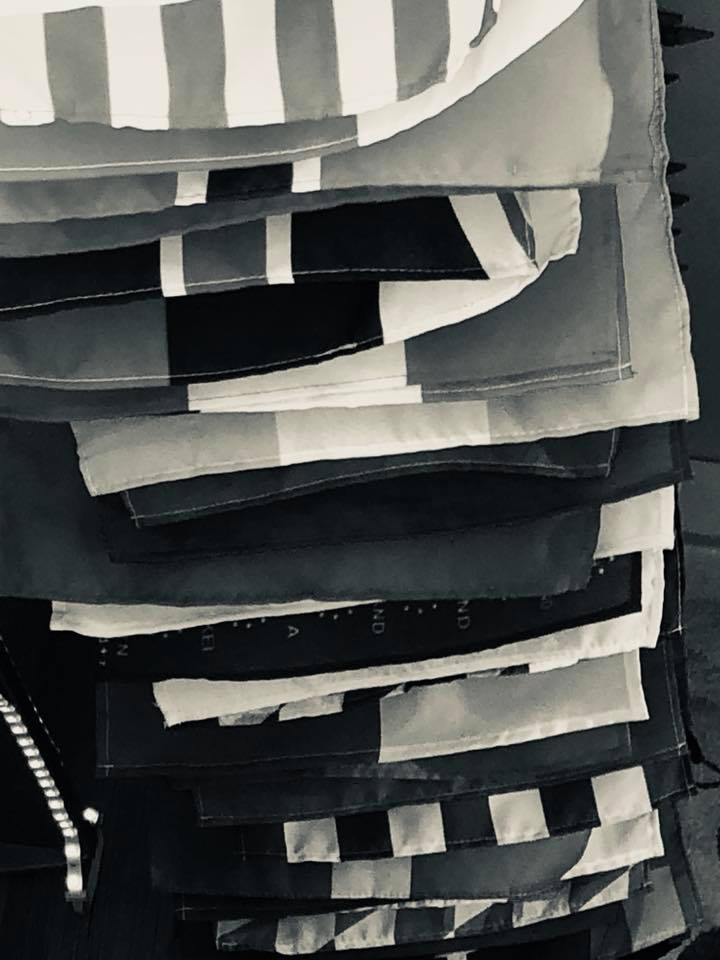
You don’t see as much of this in Australia, though it is getting worse…

*****

flags

proudly flapping
every where you go
patriotism overload
overwhelming, cloying
we have hung
them everywhere
outside our homes
along the roads
on tree branches
twigs, bushes, brambles
caught on wire
strung from fences
in towns, cities
& isolated country
hideaways
places you wouldn’t
places they shouldn’t
shreds of flag
shards of flag
a sliver, a scrap, a slip
the smallest fragment
enough to remind us
you can’t escape
the jingoistic fervour 

despite the propaganda
it’s hard to take pride
in any of our billion
billion plastic pennants

18b flags.jpg